World's Largest Gen-Z Protest Exposed India's Media Trust Crisis, International Researchers Find
A German peace institute's study and AFP reporting reveal how the Cockroach Janta Party's 36-day campaign laid bare a collapse in trust toward legacy broadcasters, even as pellet guns and internet shutdowns met student demands.
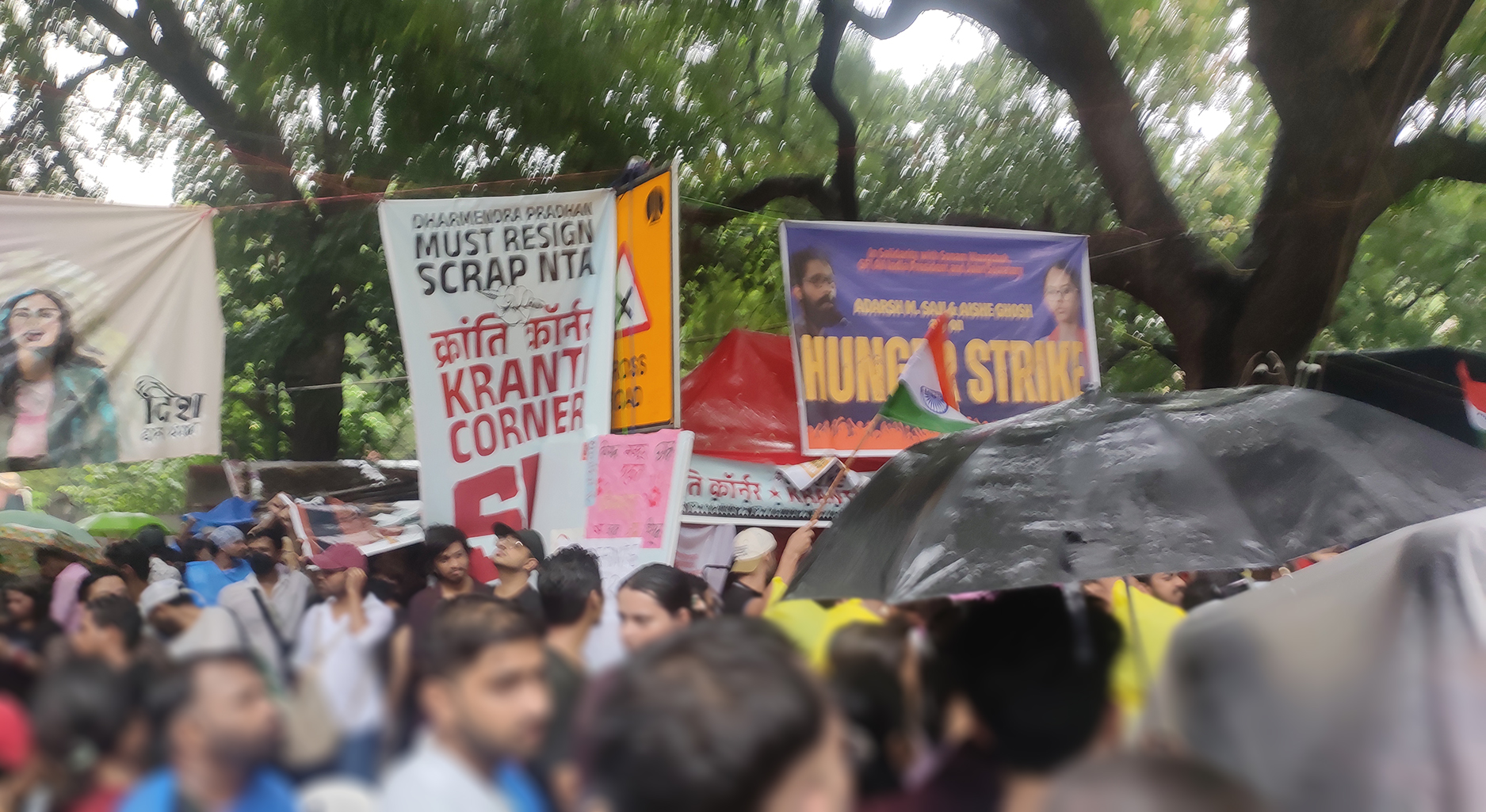
NEW DELHI — From June 6 to July 25, India witnessed what researchers at the Peace Research Institute Frankfurt (PRIF) call the world's largest Gen-Z protest movement. Led by the Cockroach Janta Party (CJP) and a coalition of student organisations, it mobilised tens of thousands across class, caste and religious lines. Yet the physical occupation of Jantar Mantar tells only half the story. A parallel crisis unfolded in how Indians consume and trust news — one that international observers say may outlast the barricades.
From a slur to a movement
The spark was a Supreme Court hearing in May. Chief Justice Surya Kant compared unemployed youth to "cockroaches." The insult was reclaimed within hours. "Main Bhi Cockroach" — I too am a cockroach — flooded Instagram, WhatsApp and X. Abhijeet Dipke, a Boston University graduate, registered the satirical Cockroach Janta Party. Its Instagram follower count hit 22.5 million within days, roughly triple the ruling BJP's tally.
What began as meme warfare escalated into a 36-day encampment at Jantar Mantar. The trigger was the NEET-UG medical entrance exam — leaked 110 times according to a dataset covering 2004-2026, the majority post-2014. In 2025, 2.2 million students sat the test. Only 118,000 secured a medical seat. At least 20 students died by suicide in the aftermath, their families blaming the scandal.
The movement demanded Education Minister Dharmendra Pradhan's resignation, ₹1 crore compensation for bereaved families, and systemic reform. Environmentalist Sonam Wangchuk joined, fasting for 26 days before being removed from the site on July 18 — an episode PRIF describes as "forceful removal" concealed by white linens.
July 20: the crackdown
On the first day of Parliament's monsoon session, the "Chalo Sansad" march met barricades, batons, tear gas and — verified by UK ballistics experts Philip Boyce and NR Jenzen-Jones — pellet guns. PRIF reports "at least one person lost partial eyesight." Video footage showed women assaulted. A 1.5-kilometre broadband shutdown, enforced by jammers for five days without public suspension orders, severed protesters' communications. They turned to Bluetooth mesh apps like Bitchat — until the government ordered GitHub to disable the repository.
"Internet shutdowns have become a common method used by government bodies to gain control over protests," the PRIF study notes. "It was not the first time the Indian government had resorted to such measures."
The media trust vacuum
While legacy broadcasters stayed away from Jantar Mantar's early days, independent journalists and digital collectives became the movement's lifeline. Priyanshi Sharma (Peek TV), Faye D'Souza (Beetroot News) and Kavya Karnatac livestreamed daily. Their footage documented the July 20 violence and built the "Wall of Shame" protesters erected at the site.
But the absence of mainstream coverage bred hostility. AFP, reporting via UCA News on August 6, describes a "deepening crisis of trust in traditional broadcasters." At Jantar Mantar, protest signs branded TV channels "India's worst enemies." The term godi media — lapdog media — echoed through crowds.
The backlash turned physical. Times Now reporter Dev Kotak was slapped, kicked and chased by a crowd in Delhi; three colleagues were harassed. A Zee TV journalist was heckled live in Mumbai. Another was pursued in Patna. Some TV crews began concealing logos and mic flags. "The mainstream media has completely sold out to the government," a private-sector employee told AFP.
Structural rot, not just sentiment
Reporters Without Borders downgraded India from rank 151 to 156 (PRIF) or 157 (AFP) out of 180 in its 2026 World Press Freedom Index — a drop of 17 places since 2013. Managing editor of Newslaundry, Atul Chaurasia, told AFP the government "weaponises advertising" to enforce compliance. Veteran journalist Ravish Kumar argued the anger reflects a perception that "godi media outlets have become a liability, even for Prime Minister Modi."
Independent journalists face a different pressure: raids, "anti-national" branding, imprisonment. The distinction matters. "It is the alternative media and independent journalists who face hostility from the government," Kumar told AFP.
What remains
On July 25, Pradhan resigned. Pralhad Joshi took the portfolio. The government agreed to the CJP's demands — fast-track courts for paper-leak cases, Nandan Nilekani to lead exam reform, compensation for suicide-affected families. Yet by July 26, protest slogans were painted over in white. Families still await compensation. FIRs filed against protesters in Delhi and Bihar were quickly revoked but sowed doubt about the truce's durability.
PRIF concludes: "This movement may not have mobilised the largest or most heterogeneous crowds over the past decade. Yet it politicised many first-time protesters and introduced a novel protest culture centred on satire and humour." The CJP plans to meet the government in four weeks on education reform — and has announced it will return to the streets if commitments lapse.
What we can verify
- PRIF study published 5 August 2026 documents the protest timeline, demands, and state response with specific data points (NEET leak count, unemployment rate, medical seat numbers, casualty details).
- AFP via UCA News published 6 August 2026 reports verified attacks on Times Now, Zee TV and Patna journalists; cites RSF 2026 rank 157/180.
- Both sources independently cite Reporters Without Borders press freedom index decline (PRIF: 156, AFP: 157 — minor methodological variance).
- Sonam Wangchuk's 26-day hunger strike and removal on 18 July confirmed by multiple international outlets (BBC, Reuters, AP, Al Jazeera).
- Education Minister Dharmendra Pradhan's resignation on 25 July confirmed by AP, BBC, Reuters, DW.
What remains unverified
- Exact pellet-round count on July 20 (PRIF cites "at least seven rounds reported and verified" but RAF and Delhi Police deny).
- Total protester headcount across all cities — "tens of thousands" is PRIF's characterisation; no independent crowd audit exists.
- Whether the GitHub takedown of Bitchat was a formal legal order or informal pressure — PRIF states "the Indian government soon ordered Microsoft's GitHub to disable the app" without citing the specific instrument.
- Long-term durability of the CJP-govt agreement; the four-week reform dialogue has not yet commenced.
[Source: PRIF Blog, "Student Protests in Delhi and India 2026: Gen-Z's Frustration and Fight for Reforms", 5 August 2026; UCA News / AFP, "India youth protests highlight mistrust in 'lapdog' media", 6 August 2026]
Sources cited
CJP policy: every fact in this article is traceable to a public source. We never publish what we cannot verify.
- ›PRIF Blog — Student Protests in Delhi and India 2026: Gen-Z's Frustration and Fight for Reforms — https://blog.prif.org/2026/08/05/student-protests-in-delhi-and-india-2026-gen-zs-frustration-and-fight-for-reforms/
- ›UCA News / AFP — India youth protests highlight mistrust in 'lapdog' media — https://www.ucanews.com/amp/india-youth-protests-highlight-mistrust-in-lapdog-media/114653
Got a tip on this story? Our newsroom follows up on every lead. Reach us via the submission page.