CSM: Cockroach Protests Crack Modi's Strongman Image
Christian Science Monitor says India's Cockroach Janta Party forced a rare minister exit, reopening space for dissent after a decade of political freeze.
Boston's Christian Science Monitor has filed one of the clearest foreign-desk readings yet of what the Cockroach Janta Party (CJP) actually changed in New Delhi. The 30 July piece does not treat Education Minister Dharmendra Pradhan's exit as a one-day scandal. It treats the resignation as the first public crack in a twelve-year posture that, until this month, refused to sacrifice cabinet colleagues under street pressure.
"Indian Prime Minister Narendra Modi has spent 12 years in office cultivating an image as a leader who does not bend to pressure," the Monitor writes. His government, it notes, "was steadfast in the face of multiple protests, quick to curb dissent, and, unlike its predecessors, did not ax ministers in times of crisis. Until this week."
What the Monitor argues
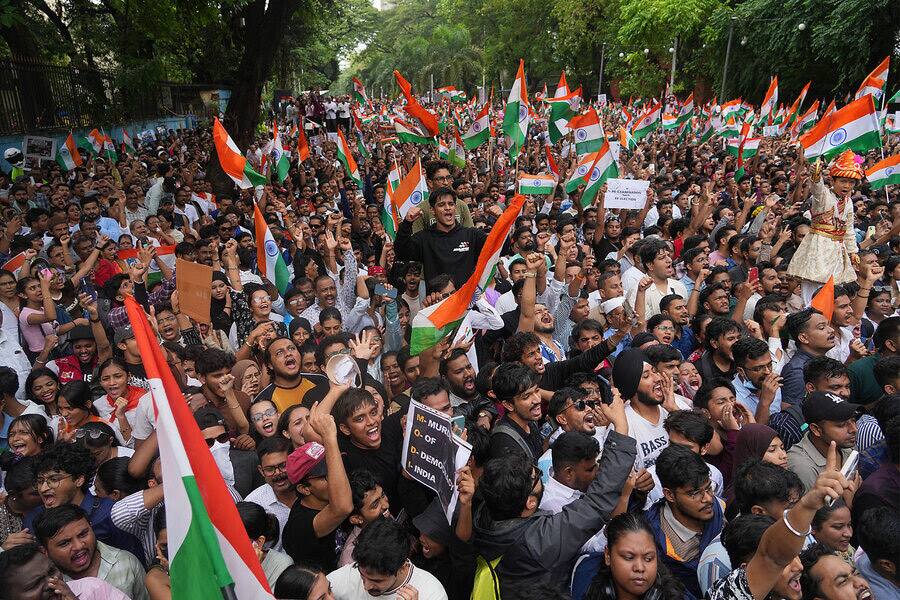
The paper walks the arc that international desks have been reconstructing all month: a youth camp at Jantar Mantar, a march on Parliament, arrests, and a government that finally blinked. Pradhan's resignation letter, the Monitor reports, framed the exit as a sacrifice "to spare the nation from chaos."
The more interesting claim is cultural, not procedural. University of Delhi professor Apoorvanand tells the paper that Indian politics had settled into "an air of pessimism and defeatism," with opposition parties "fractured and demoralized." The CJP, he says, "has jolted [the country] awake." Sociologist Surinder S. Jodhka of Jawaharlal Nehru University goes further: recent events punctured what he calls a "kind of deification" of the prime minister — not only because a minister fell, but because a generation of protesters showed "a complete lack of reverence" for the political establishment.
The Monitor also revives a 2015 clip of then-Home Affairs minister Rajnath Singh declaring "Ministers don't resign here" — a line now circulating as a contrast to Pradhan's departure. That framing matches what CNBC and Chatham House have already documented from other desks: the resignation is rare inside Modi's tenure, and its rarity is the point.
Copycats and the next test
CJP founder Abhijeet Dipke, the Monitor notes, told supporters as the Delhi camp came down: "This is not the end. We will meet again soon." Movement leaders say they are "resting and regrouping" and plan to "put our weight behind one issue at a time."
That template is already being borrowed. Within days of Pradhan's exit, a social-media campaign calling itself the E20 Janta Party began demanding the road transport minister's resignation over ethanol blending in petrol. Taxi unions have joined; a march on Parliament was planned for 4 August. The Times of India and CNBC have independently reported the same copycat dynamic.
Atlantic Council South Asia fellow Michael Kugelman, quoted by the Monitor, floats a narrower electoral test: even if the ruling Bharatiya Janata Party holds Uttar Pradesh next year, a thinner margin — what he calls the "Cockroach factor" — would signal that the youth wave still registers at the ballot box. That forecast is analysis, not a measured result.
What we can verify
- The Christian Science Monitor published a reported analysis on 30 July 2026 arguing that the CJP forced a rare ministerial resignation and reopened space for public dissent under Modi (CSM).
- CNBC's 27 July desk piece independently frames the same climbdown as exposing "chinks" in the ruling party's armour and notes the galvanising effect on other civil-society campaigns (CNBC).
- Chatham House's 29 July expert comment treats the CJP mobilisation as real but structurally constrained — a second independent foreign analysis of the same post-resignation moment (Chatham House).
- The Times of India confirmed the E20 Janta Party campaign that formed after CJP's win and the demand for a no-ethanol fuel option (TOI).
What remains unverified
- Whether the "Cockroach factor" will narrow BJP margins in Uttar Pradesh remains [unverified] forecast, not election data.
- Exact nationwide participant counts across all CJP-linked city rallies remain [unverified]; no consolidated official tally has been released.
- Claims that every opposition party has been "jolted awake" into a durable strategy remain [unverified] opinion from quoted analysts.
Sources cited
CJP policy: every fact in this article is traceable to a public source. We never publish what we cannot verify.
- ›The Christian Science Monitor — In Modi’s India, many felt dissent didn’t matter. Then came the ‘cockroaches.’ — https://www.csmonitor.com/World/Asia-South-Central/2026/0730/cockroach-movement-india-modi-dissent-education
- ›CNBC — India's Gen Z forced Modi to listen, respond and act — exposing chinks in the ruling party's armor — https://www.cnbc.com/2026/07/27/india-cjp-modi-protest-genz-jobs.html
- ›Chatham House — Has the 'Cockroach' movement changed Indian politics? — https://www.chathamhouse.org/2026/07/has-cockroach-movement-changed-indian-politics
- ›Times of India — CJP's win fuels call by E20 Janta Party for no-ethanol option — https://timesofindia.indiatimes.com/india/cjps-win-fuels-call-by-e20-janta-party-for-no-ethanol-option/articleshow/132648142.cms
Got a tip on this story? Our newsroom follows up on every lead. Reach us via the submission page.