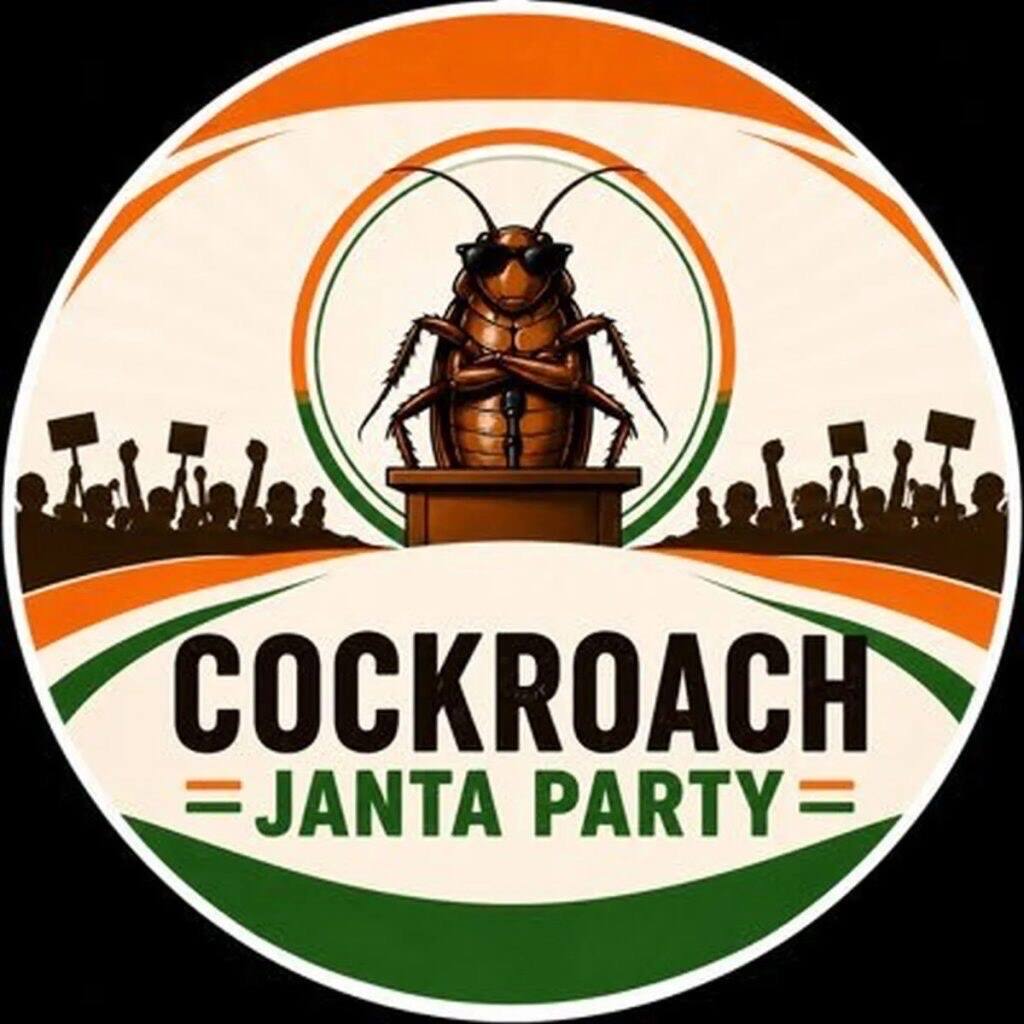
Chatham House: CJP Tapped Gen Z Anger But Faces Structural Limits
Chatham House analysis finds the Cockroach Janta Party channelled youth frustration over exams and jobs, yet India's centralised state and fragmented opposition make a neighbour-style Gen Z revolution unlikely.

London desks spent the last week shifting from blow-by-blow protest logs to a harder political question: does the Cockroach Janta Party’s forced resignation of an education minister mark a one-off climbdown, or a lasting crack in Prime Minister Narendra Modi’s grip on the national narrative?
A new Chatham House expert comment published 29 July — titled “Has the ‘Cockroach’ movement changed Indian politics?” — argues the former. Authored by Dr Chietigj Bajpaee, senior research fellow for South Asia at the institute’s Asia-Pacific Programme, the piece treats the CJP sit-in as a real mobilisation that tapped structural grievances, but concludes India’s institutional architecture and Modi’s entrenched position make a neighbour-style Gen Z revolution unlikely.
The analysis arrives as international correspondents file their post-protest assessments. The BBC profiled Mohammad Junaid, a 24-year-old law student who ran a community kitchen at Jantar Mantar for 35 days and has since petitioned the Supreme Court alleging unlawful detention. A second BBC piece examined why digitising exams — the government’s headline reform — will not fix a system where the root of trust lies in human question-setters. Deutsche Welle documented how the “criminal antecedents” caveat in state withdrawal orders has become a new battleground, with student leaders warning of selective prosecution.
From meme to mobilisation
The CJP began in May as a satirical Instagram handle, riffing on Chief Justice Surya Kant’s remark that unemployed youth were “cockroaches” and “parasites.” Within weeks it had 22 million followers and physical encampments at Delhi’s Jantar Mantar. The trigger was the NEET medical entrance leak — over 2.2 million candidates, at least a dozen suicides linked to the scandal, and a long run of exam scandals (the National Crime Records Bureau recorded 14,488 student suicides in 2024, up roughly 80 per cent from 2014).
Protests spread to Mumbai, Pune, Bengaluru and Patna. Veteran activist Sonam Wangchuk’s hunger strike and his forcible removal galvanised crowds. Police baton charges and tear gas on 20 July, as thousands marched toward Parliament, went viral and drew opposition politicians and celebrities into the frame. On 26 July, Education Minister Dharmendra Pradhan resigned — the first senior minister to fall to public pressure in Modi’s twelve years.
What Chatham House sees
Bajpaee identifies three structural brakes.
First, the CJP is not (yet) a political party. Its demands were narrowly framed around exam reform and ministerial accountability. Opposition politicians offered moral and material support, but no unified political vehicle exists to convert street momentum into electoral leverage.
Second, the Modi government sits on stronger footing than the ousted regimes in Sri Lanka (2022), Bangladesh (2024) or Nepal (2025). The BJP and allies control 22 of 36 states and union territories. There is no cohesive national opposition. “Grassroots movements face a high barrier to translate their protest support into political power in India,” the piece notes.
Third, the grievances are structural, not episodic. Nearly 40 per cent of school graduates aged 15–25 are unemployed, per Azim Premji University’s State of Working India 2026. The exam system is over-centralised under the National Testing Agency; coaching is a multi-billion-dollar industry; question-setters number only a few dozen. “If even one person in that entire set is compromised, we are gone,” IIT Madras director V. Kamakoti told the BBC.
The legal afterlife
DW’s Murali Krishnan reports the battle has shifted from streets to police stations and courtrooms. State governments in Delhi, Bihar, Assam, Maharashtra and West Bengal announced case withdrawals, but each order carried a “criminal antecedents” qualifier — a condition student leaders say was never negotiated. Senior advocate Rebecca Mammen John told DW that oral assurances count for nothing without the prescribed legal process; ultimately courts decide.
Mohammad Junaid’s Supreme Court petition alleges overnight detention and interrogation a day before the protest ended. In Uttar Pradesh and Bihar, protesters describe home visits, questioning based on CCTV and photographs, and social media monitoring. The BJP did not respond to DW’s requests for comment. The Supreme Court, led by Chief Justice Surya Kant, said both police and protesters would be held accountable for violations.
What the press gets right — and where the gaps remain
International outlets correctly frame the CJP as a Gen Z-led, digitally native movement that forced a rare ministerial exit. They accurately trace the trigger to NEET leaks and the deeper jobs crisis. They note the satire-to-streets trajectory and the role of humour, memes and reels in lowering participation barriers.
What remains less examined: the Nilekani task force’s actual mandate and timeline; whether computer-based testing can address pre-print leaks (the 2026 leak allegedly occurred before the paper left the NTA); the fiscal and administrative feasibility of the CJP’s five-point charter; and whether the “E20 Janta Party” — a copycat movement against ethanol-blended fuel mandates — signals fragmentation or diffusion.
What we can verify
- Chatham House published an expert comment on 29 July 2026 by Dr Chietigj Bajpaee analysing the CJP’s limits and structural grievances. — Chatham House
- The BBC profiled Mohammad Junaid, a CJP volunteer who has petitioned the Supreme Court alleging unlawful detention; the piece is dated 30 July 2026. — BBC News
- The BBC reported that digitising exams alone will not stop leaks, citing IIT Madras director V. Kamakoti and the Supreme Court’s caution; dated 29 July 2026. — BBC News
- Deutsche Welle documented the “criminal antecedents” caveat in state withdrawal orders, ongoing police monitoring, and the legal fight over case withdrawals; dated 31 July 2026. — Deutsche Welle
What remains unverified
- Exact number of protesters detained, released, or still facing charges — [unverified] (state orders differ; no consolidated public list).
- Whether the Nilekani task force will recommend a full shift to computer-based NEET — [unverified] (task force deliberations ongoing).
- Scale of social media takedowns or shadow-banning of CJP content — [unverified] (Instagram users report disappearing posts; no platform transparency data).
Sources
Primary links are in the frontmatter. For the Chatham House analysis, open the institute’s site. For the human-angle and policy detail, the BBC and DW pieces are the clearest English-language reads.
Sources cited
CJP policy: every fact in this article is traceable to a public source. We never publish what we cannot verify.
- ›Chatham House — Has the 'Cockroach' movement changed Indian politics? — https://www.chathamhouse.org/2026/07/has-cockroach-movement-changed-indian-politics
- ›BBC News — 'I won't stop fighting,' says 'cockroach' protester after alleged detention — https://www.bbc.com/news/articles/c4gwdz3z5gzo
- ›BBC News — India's CJP protests: Why tech alone won't stop exam paper leaks — https://www.bbc.com/news/articles/c1m1gz1nx45o
- ›Deutsche Welle — India's 'Cockroach' protesters face ongoing legal pressure — https://www.dw.com/en/indias-cockroach-protesters-face-ongoing-legal-pressure/a-78190610
Got a tip on this story? Our newsroom follows up on every lead. Reach us via the submission page.