
Jantar Mantar protest generates 15,000 kg waste daily as NDMC struggles with cleanup
NDMC lifts 15,000 kg of garbage daily from Jantar Mantar protest site; police permission delays and volunteer efforts fill the sanitation gap.
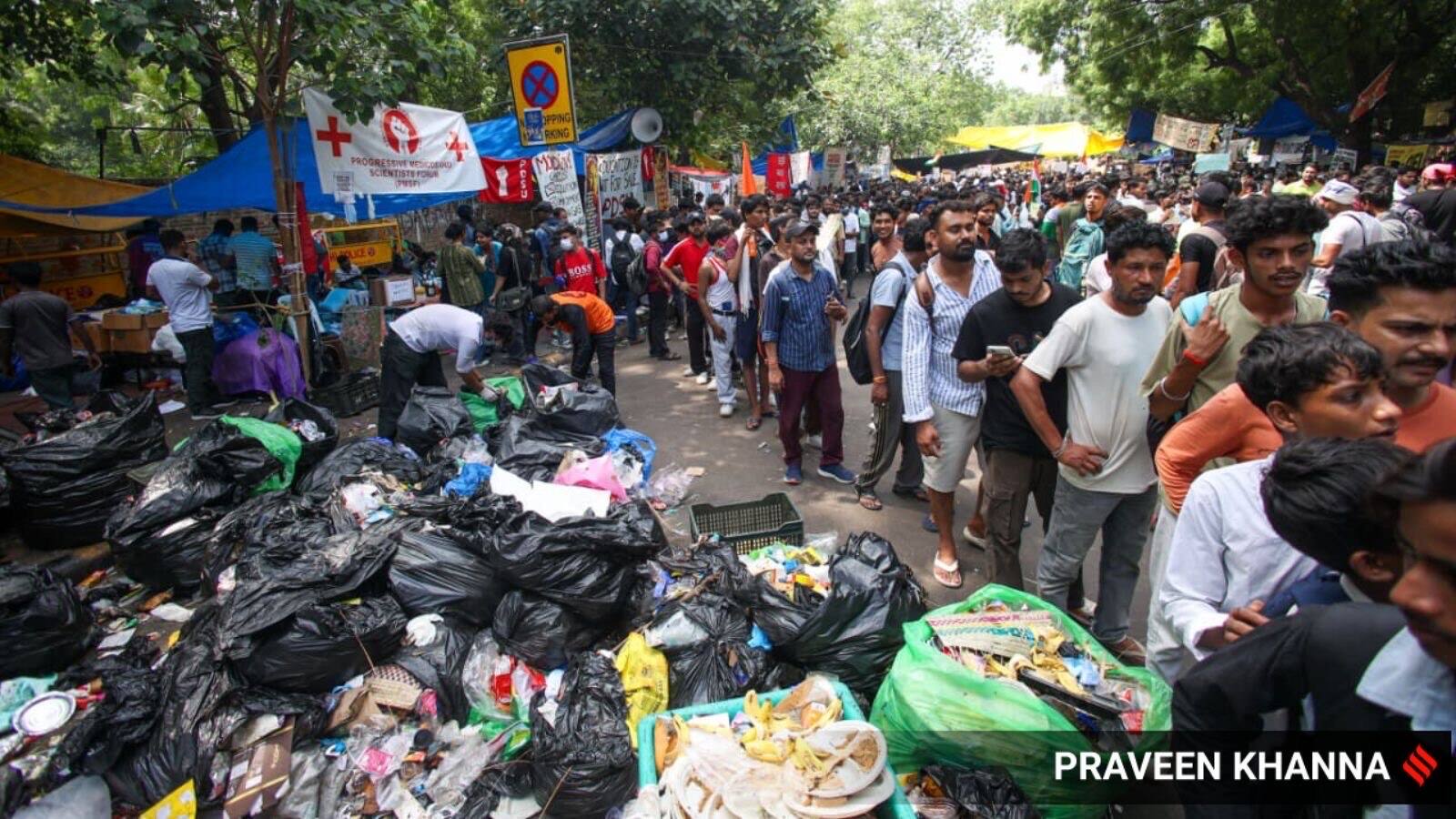
At Jantar Mantar, the crowds are growing every day. So is the garbage.
New Delhi Municipal Corporation (NDMC) officials say they are now lifting nearly 15,000 kg of waste every day from Tolstoy Marg, Sansad Marg and Jantar Mantar Road — up from a baseline of 500–600 kg before the Cockroach Janta Party (CJP) protest began.
“There is no standard waste management protocol when more than 5,000 people gather every day,” an NDMC official told The Indian Express. The corporation has deployed extra workers in three shifts: about 50 in the morning, 15 in the afternoon, and 20 in the evening.
Police permission delays have complicated the operation. NDMC teams need clearance to enter the protest zone, and that clearance does not always arrive on time. On several days, workers could not reach the inner lanes until late morning, leaving overnight waste uncollected for hours.
Volunteers and informal recyclers have stepped into the gap. Protesters themselves run cleanup drives each morning, segregating plastic bottles and food packets. Scrap collectors — mostly migrant workers — gather recyclables from the site, earning ₹15–20 per kg of PET bottles. Their presence reduces the load on municipal staff but also raises questions about occupational safety; none of the collectors The Indian Express spoke to had gloves or masks.
Portable toilets remain scarce. The Sachkhand Foundation has installed 15 mobile units near the stage, but protesters say the ratio is roughly one unit per 300 people. Open defecation along the side lanes has been reported, increasing the risk of water‑borne illness.
Doctors at a makeshift clinic near the stage say they are treating 30–40 cases daily of skin infections, diarrhoea, and respiratory irritation — conditions they link to the accumulated waste and poor sanitation. No official health department bulletin has confirmed an outbreak.
What we can verify
- NDMC’s daily waste collection at the protest site has risen from ~600 kg to ~15,000 kg (NDMC official, Indian Express, 25 July 2026).
- Cleanup operates in three shifts with 85 total workers deployed (same source).
- Police permission is required for NDMC entry; delays have occurred (same source).
- Volunteers run morning segregation drives; informal scrap collectors operate on site (reporter observation, Indian Express).
- Sachkhand Foundation has provided 15 portable toilets (reported by Indian Express).
- Makeshift clinic reports 30–40 daily cases of infections and irritation (clinic staff, Indian Express).
What remains unverified
- Exact protester headcount (organisers claim >10,000; police have not released a figure).
- Whether the skin and gastric cases constitute a clinical outbreak (no Delhi health department statement).
- Long‑term environmental impact on the storm‑water drains feeding the Yamuna (no test data published).
The protest shows no sign of ending. Until it does, the 15,000‑kg daily heap will keep growing — and the gap between municipal capacity and ground reality will stay visible on the streets of Lutyens’ Delhi.
Sources cited
CJP policy: every fact in this article is traceable to a public source. We never publish what we cannot verify.
Got a tip on this story? Our newsroom follows up on every lead. Reach us via the submission page.