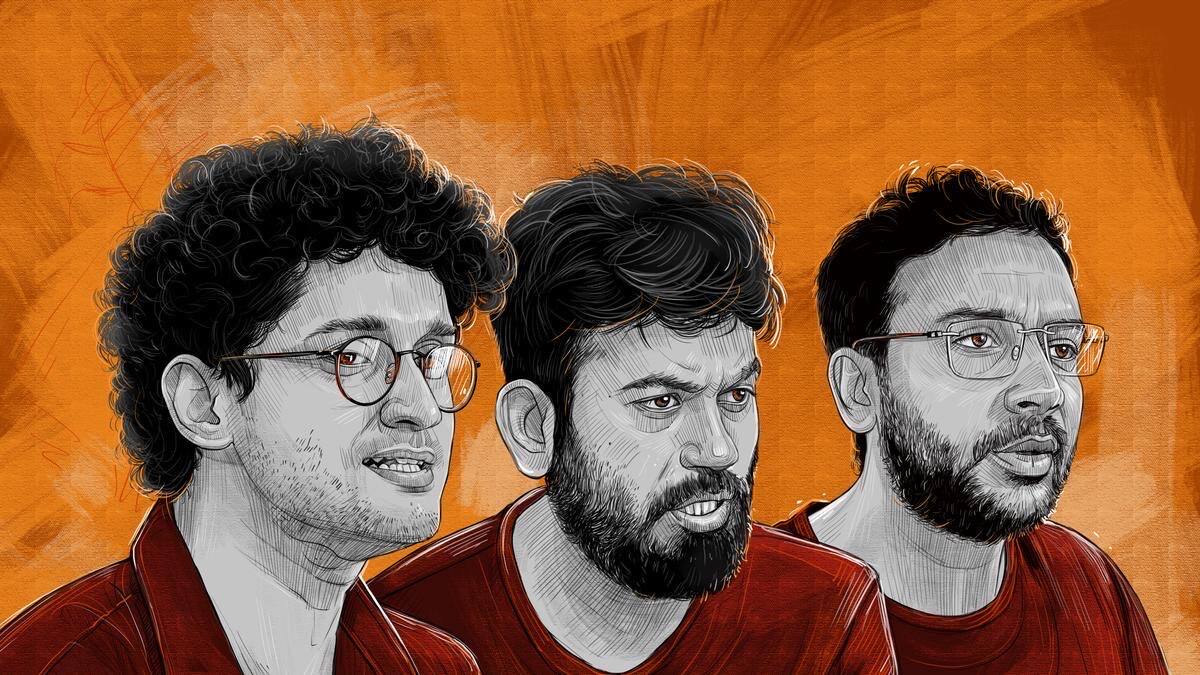
Dipke, Ranka, Das: three faces of the Cockroach revolt
The Hindu maps how Abhijeet Dipke, Ashutosh Ranka and Saurav Das turned a satirical 'cockroach' post into the student protest that forced Education Minister Pradhan out.
From satire to sit-in is the most popular, and perhaps the easiest, explanation for the student protest movement that culminated in the resignation of Union Education Minister Dharmendra Pradhan. That narrative is empowering in its simplicity. It is also incomplete.
Behind the viral posts, soaring follower counts and colourful symbolism stood a trio: Abhijeet Dipke (30), Ashutosh Ranka (30) and Saurav Das (27), whose skills complemented one another. They come from different parts of the country, different social backgrounds and possess markedly different temperaments. The Hindu's 2 August profile (by Sobhana K. Nair and Nikhil M. Babu) maps how their convergence gave the Cockroach Janta Party (CJP) an organisational spine that a meme alone could not provide.
The emotional core, the strategist, the spokesman
Those who spent time around Jantar Mantar during the 36-day protest describe Mr. Dipke as politically intuitive, at times emotional, and the beating heart of the movement. On 18 July, after activist Sonam Wangchuk was removed from the protest site, it was Mr. Dipke who argued the movement should escalate its demands beyond Pradhan's resignation to include Prime Minister Narendra Modi's resignation. He brought a sense of lightness — discussing A.R. Rahman's music, reciting Shah Rukh Khan dialogues from Swades, posing for pictures with protesters, cracking jokes in the evenings.
Mr. Ranka, by contrast, has been described as decisive, occasionally authoritarian, and quicker to lose his temper. He remains the mind of the movement and its principal strategist. An IIT-Kanpur graduate in Materials Science who served as a Delhi Assembly Fellow under Atishi during the pandemic, then earned a Master's in Public Administration at LSE, he worked at McKinsey and Gavi, the Vaccine Alliance, before pivoting to Indian public life. He ran AAP's New Delhi constituency campaign in the February 2025 Assembly election and continued defending the party publicly afterward.
Das, who spent part of his childhood in Puducherry and speaks Tamil, became the movement's spokesman at 27. A journalist before he turned protest leader, he understood newsroom rhythms, narrative shaping, and how to keep a movement in headlines. He is best known for a detailed profile of former CJI D.Y. Chandrachud for The Caravan, with bylines also in Frontline. He co-founded the Climate Action Front, an initiative focused on climate governance and environmental policy, and has been working on a debut book, Complicit Silence: The Court's Role in India's Quiet Suffering. Videos of him dancing after Pradhan's resignation went viral; he defended the celebrations as "the language of Gen Z", arguing young people express political victories differently.
AAP thread, Dalit identity, and the question of ambition
An obvious thread connecting the three is their association with the Aam Aadmi Party. Dipke and Ranka worked for the party; Das's proximity to Arvind Kejriwal is well known. None has sought to conceal the link.
Dipke was born in Chhatrapati Sambhajinagar (formerly Aurangabad), Maharashtra, into a Dalit family. His caste identity largely remained in the background during the protest. "He is a student leader who is also a Dalit and not the other way round," a leader associated with the 36-day protest told The Hindu. One occasion on which he publicly asserted it came after ink was thrown at him at Jantar Mantar on 18 July. His response was brief: "Blue is my colour. Jai Bhim."
Ranka, born and raised in Jaipur, has never hidden his political ambitions. He has often expressed a desire to focus on Rajasthan politics. After the 2025 Delhi election, he ran campaigns to protect a 100-acre forest near Jaipur and recently gave Rajasthan Education Minister Madan Dilawar a three-month ultimatum on university issues, warning the CJP would otherwise seek the vice-chancellor's resignation.
Das, who spent part of his childhood in Puducherry and speaks Tamil, became the movement's spokesman at 27. "This is proof that if you don't get scared, you can win," he said after Pradhan's resignation.
The piece notes the movement's viral origins — CJI Surya Kant's "cockroach" remark on 15 May, Dipke's satirical platform launch the same day, 50,000 sign-ups in 24 hours, a million within five days, 22 million Instagram followers. It traces the escalation to the 20 July "Sansad Chalo" march, police response with tear gas, batons, and alleged pellet guns, Wangchuk's 21-day hunger strike ending in hospitalisation, and Pradhan's resignation on 25 July.
What remains less clear is the movement's next phase. CJP called off the continuous Jantar Mantar sit-in on 25 July while keeping its five-point charter — including an independent NEET probe and FIR withdrawal — on the table. The profile ends with the three leaders recuperating, their next moves unwritten. None of the three had ever led a protest of this scale before laying siege to the area near the 18th-century observatory at Jantar Mantar; nor had most of the protesters who took to Delhi's streets at their call. For now, they insist the CJP will continue as a pressure group rather than a political party.
Sources cited
CJP policy: every fact in this article is traceable to a public source. We never publish what we cannot verify.
Got a tip on this story? Our newsroom follows up on every lead. Reach us via the submission page.