
Centre tells Supreme Court it is considering a committee to re-examine UGC's 2026 equity regulations
The regulations were notified in January and stayed by the Supreme Court a fortnight later; the court has given the government four weeks.
The Union government told the Supreme Court on November 5 that it is considering appointing a committee to re-examine the University Grants Commission's equity regulations of 2026, which the court stayed in January. A Bench headed by Chief Justice of India Surya Kant adjourned the petitions for four weeks.
What happened
Solicitor General Tushar Mehta told the Bench, also comprising Justice Joymalya Bagchi, that the government was examining how to address students' concerns so that no section of the student community feels excluded, apprehensive or under threat. The court was hearing Abeda Salim Tadvi v. Union of India and connected cases.
The regulations, notified on January 13, require universities, colleges and deemed institutions to set up equal opportunity centres and equity committees to deal with complaints of discrimination. The Supreme Court stayed them on January 29, holding that they appeared vague and open to misuse, and directed that the 2012 regulations continue to operate in the interim.
What we can verify
Both outlets report the same sequence: notification in January, a stay within weeks, the Centre's submission on November 5, and a four-week adjournment. The Hindu reports that the matter arises from a 2019 petition filed by the mothers of Rohith Vemula and Payal Tadvi, both of whom died by suicide after alleging caste discrimination on campus.
Hindustan Times identifies the petitioners challenging Regulation 3(c) as activist and entrepreneur Rahul Dewan, post-doctoral researcher Mrityunjay Tiwari and advocate Vineet Jindal, with advocate Vishnu Shankar Jain appearing for Dewan. Neither outlet reports the composition, mandate or timeline of the committee the government says it is contemplating.
What each side says
Chief Justice Surya Kant told the government to revisit the framework so that it protects every student's interest. "Why don't you revisit these regulations so that the next generation is taken care of? They should protect the interest of every student," the Bench said, according to Hindustan Times.
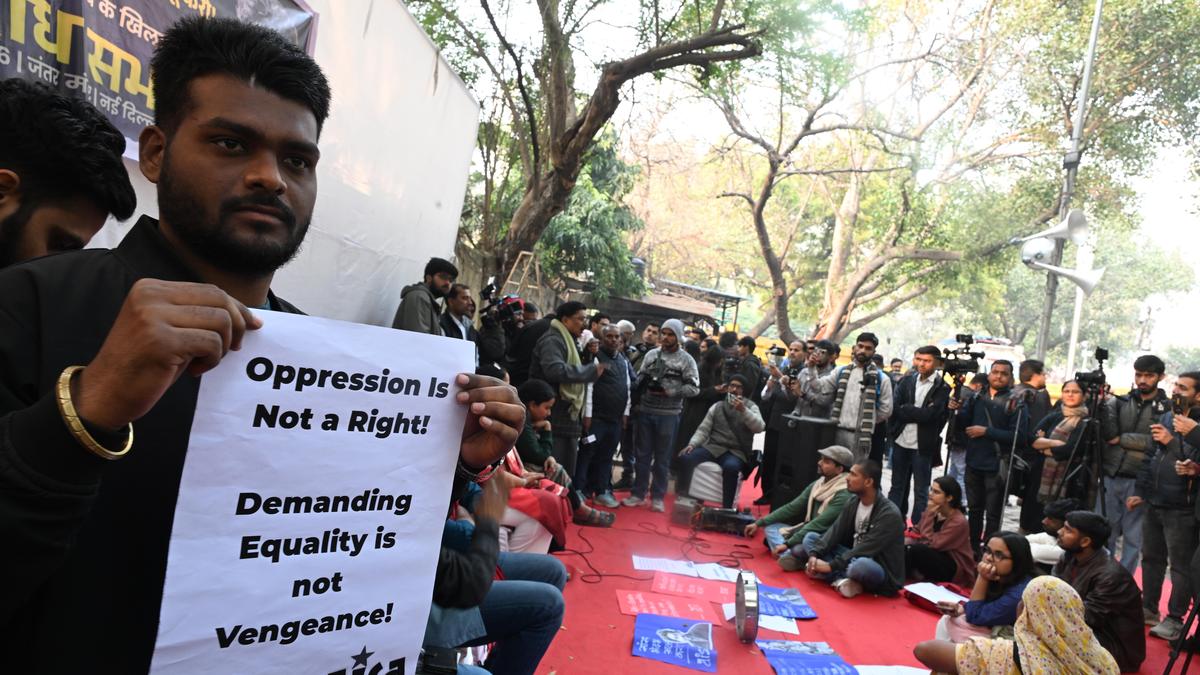
The petitioners argue that Regulation 3(c), which defines caste-based discrimination as unfair treatment of Scheduled Castes, Scheduled Tribes and Other Backward Classes, leaves out general-category students who may face discrimination, and that the rules lack an adequate check against false complaints. Groups representing marginalised students have welcomed the framework, and upper-caste student groups have protested against it, including outside the UGC office in Delhi this week.
The government has not withdrawn the regulations. It has told the court it is studying the issue.
What it means for people
For students on campus now, the practical position is unchanged: the 2012 regulations apply until the court or the government moves, so a complaint of discrimination is still handled under the older framework.
What is at stake is which students can file a complaint at all. If the 2026 definition is narrowed or widened by a new committee, the set of students entitled to protection changes, and so does the burden on institutions to run equity committees. The four-week adjournment means no change before the next hearing, and the court has recorded only advice, not a direction.
- education
- ugc
- supreme court
- caste discrimination
Sources
- The Hindu — Centre tells Supreme Court about setting up of special committee to re-examine UGC's 2026 equity regulations(opens in a new tab)thehindu.com
- Hindustan Times — Centre to set up panel to revisit UGC equity regulations, Supreme Court told(opens in a new tab)hindustantimes.com
Spotted a mistake, or know something about this story? Send a correction or tip. Corrections are appended, never silently overwritten.